

FROM THE MOON TO MUD: WHY EARTH’S FINAL FRONTIER LIES BENEATH OUR FEET


Of all the world records ever broken, perhaps the most striking has just happened beyond our planet. With Artemis II, humans travelled further from Earth than ever before, circling the Moon before splashing down safely back home. But amid the technical triumph, it was a quiet reflection from space that mattered most. Gazing back at Earth, pilot Victor Glover spoke of our planet as a rare “oasis” in a vast emptiness – a reminder, he said, of who we are and that we must get through this together. It is a lesson worth bringing firmly back down to Earth.
NASA described Artemis II as ushering in “a new era of human space exploration”, and rightly so. The mission has reignited awe, curiosity and optimism about what lies beyond our world. Yet Glover’s words captured something deeper than technological prowess. Sometimes, it takes travelling vast distances from home to truly understand its value.
For all its brilliance, Artemis II was not immune to the everyday realities of being human. Toilet troubles caused by a frozen waste vent meant the spacecraft’s washroom facilities couldn’t function as designed. It was a relatable reminder that even a multibilliondollar vehicle built to conquer space can be undone by the most basic of necessities.
Nevertheless, four crew members travelling in a cabin the size of a camper van have rightly stirred our imaginations about the mysteries of the Moon and Mars. Yet it might be Glover’s invitation to recognise just how “special” life on Earth really is that offers the most profound learning – that one of the greatest frontiers of discovery lies not above us, but beneath our feet.
Final Frontier
Imagine waking up to the news that scientists had discovered a new world, teeming with life. A world barely explored, where the number of creatures could take decades to name and identify.
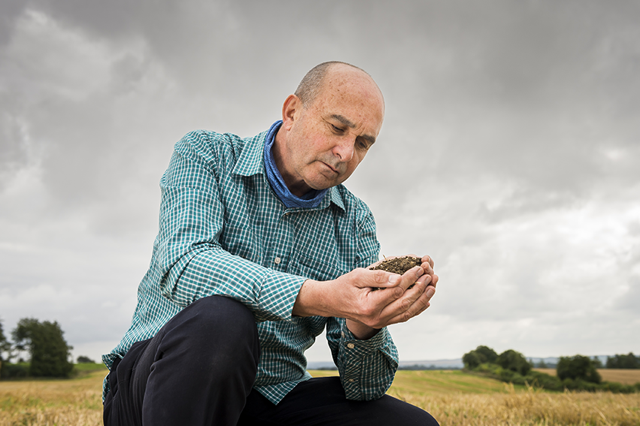
In truth, that world already exists – it is the soil beneath us – Earth’s final frontier. Each small handful of healthy soil contains more living organisms than there are people on the planet.
We rely on it for nearly all our food, for climate stability and for stopping rainwater simply running back out to sea. Yet across the globe, we treat soil like dirt.
That waferthin skin covering the Earth holds around a quarter of the planet’s biodiversity. Worms, fungi and countless microscopic organisms teem in healthy soils. There are around 30,000 species of earthworm worldwide and an estimated five million species of fungi that bind soil together, transport nutrients and help landscapes soak up water. Soil even has its own microbiome, containing at least a million species of bacteria.
One can only imagine the reaction at NASA if a space rover turned up anything like this abundance of life. In the mid1990s, the faintest hint of fossilised bacteria on a meteorite from Mars sparked headlines proclaiming that we might not be alone in the universe.
Yet the living world we walk upon every day receives scant attention.
After around 10,000 years of civilisation, much of the life beneath our feet remains unnamed.
Leonardo da Vinci observed, “We know more about the movement of celestial bodies than about the soil underfoot”. Five hundred years on, that pretty much remains true.
Essential to life
What makes this neglect even more extraordinary is that soil holds the key to our own survival. Beyond its astonishing biodiversity, it locks carbon away from the atmosphere, recycles nutrients and regulates water.
That shallow layer of topsoil – with an average depth of little more than a foot – contains nearly twice as much carbon as the atmosphere itself. If we treat it well, it could store even more, making soil one of our most powerful allies in tackling the climate crisis.
Soil also underpins water security. Around 90 per cent of global agricultural production depends on the water held in soils.
Healthy soil acts like a sponge, holding moisture close to plant roots. Degraded soil, by contrast, can hold less than half that amount. The rest rushes into rivers and streams, carrying nutrients and chemicals with it, polluting waterways and fuelling oxygen starved dead zones in seas and lakes.

Commonsense
The ageold wisdom of mixed farming – rotating crops, replenishing soils with manure, resting land under grass and integrating freeranging animals – has too often been abandoned. Crops and animals have been separated, natural nutrient cycles broken and soils reduced to a lifeless medium for chemical inputs. Harmful chemical-driven industrial agriculture has become all the rage.
The consequences are stark. Soils are eroding up to a hundred times faster than they are being formed. Around a third of the world’s soils are already degraded, and the true figure is thought to be higher, masked by intensive fertiliser use. According to the UN Food and Agriculture Organization, unless new approaches are adopted, the amount of productive land per person in 2050 will be just a quarter of what it was in 1960.
And yet, there is hope. Naturefriendly, organic and regenerative farming shows that another path is not only possible, but practical. By rebuilding soil life, reducing chemical inputs, restoring animals to mixed farming systems and keeping land covered with diverse crops, we can regenerate fertility, store carbon, conserve water and grow food more resiliently.
As astronauts peer back at our blue planet from the darkness of space, perhaps the greatest lesson is this: Earth is rare, interconnected and fragile. Our future will not be secured by escaping it, but by understanding it – beginning with the astonishing universe beneath our feet.
Note: This is a version of an article that first appeared in The Scotsman on Friday 17th April, 2026