
WALKING ON THE WILD SIDE


A special guest blog from beloved Compassion Patron, poet and author Sir Michael Morpurgo
The nineteen sixties and seventies saw an awakening of understanding about the fragility of the planet and about our burgeoning urbanisation, our exploitation and erosion of the natural world around us, and also with our growing alienation from the countryside, farming and wild life.
There were the books. Rachel Carson’s Silent Spring came out, and children world wide were growing up reading The Little Prince by Antoine de St Exupery, and I was being read Kenneth Graham’s Wind in the Willows, or Beatrix Potter, then I was discovering The Man who Planted Trees by Jean Giono.
On film and on television, Jaques Cousteau and David Attenborough and the BBC were opening our eyes to the wild world about us, enchanting us, reconnecting us, reminding us of the wonders of our world, and our responsibility for it, of the need to live harmoniously, to tread softly, to understand more where our food comes from. And today Chris Packham and Countryfile and many others keep us in touch with the countryside and the seasons, reminding us of the wonder all around us.
And then Peter Roberts was creating Compassion in World Farming, that has raised awareness nationally and internationally. There were deaf ears of course, but enough people in country and town were already predisposed to realise the need to think again about farm and food and growing.
There was ever more Interest in gardening, use of allotments was widespread, due in large part at least to the influence of radio and television. The post Industrial Revolution revival of interest and enthusiasm for the great outdoors was alive and kicking. There were more champions for the countryside for farming, who were banging the drum, raising awareness of the need to understand better where our food comes from, how it is produced and who produces it. The shelves and tables in bookshops are crowded now with books on the countryside, like Raising Hare, and The Shepherd’s Life, and our screens and radios are filled with programmes that tell the story of life on the land, of walking on the wild side.
It is true the every wildlife and farming programme we see or hear, from The Archers, to Jeremy Clarkson, to Clare Balding, every book, every film, helps us to understand the life of the countryside better, the delicate balance of good food production with nature, the hard work of creating our food, the effect of climate change, the causes of climate change, the benefits the countryside bring us, the great fragility of nature we have so long ignored.

I come from a generation that was first of all ignorant of the stresses we put upon our environment, but as the decades passed we came to realise, all too slowly, how we had undervalued our farming, our fellow creatures, our natural world. We took it all for granted.
Compassion in World Farming, and with it the rewilding movement, with pioneers like Isabel Tree, have helped bring us down to earth, to suggest a course towards a more thoughtful sensitive agriculture which works hand in hand with nature, leaving room for larks and nightingales, for butterflies and bees, for hedges and wild flowers, a kinder more compassionate course, that acknowledges that farmers need to make a living because we need the food, but that it has to be done sustainably and sympathetically, that we have farm alongside nature, that our rivers – the great barometers of the countryside must be clean – that three trees must always be planted to replace one.
But there is another vital way we can feel more connected to farming and the countryside, to renew our sense of belonging to the land and our responsibility for it. Education. The countryside is a vast and largely unused resource for children. And as with reading, the best way to encourage children to a love of the country, is to introduce them to it, young. We have to take them there, to walk, to breathe it in, to feel the wind in their faces, to roll down hills, to tramp through mud, to walk through a whispering wood, to see a heron rising from the river.

50 years ago this year, there began a pioneer farming project designed to bring city children – to whom the farm is another world – to stay in the countryside and to work down on a farm in Devon. It was Clare Morpurgo’s great notion. An urban child herself, she had loved coming down to Devon with her father, the great Devonian ,Allen Lane, who began Penguin Books. She fell in love with the place and the people.
As an eight- year old she would put on her wellies every day and go for walks on the wild side. Here for the first time she saw lizards, slow-worms, picked up caterpillars, collected wild flowers to press in her diary, got to know farmers, drank their lemonade, help bottle feed lambs, groom farmhorses, watch trout and stickleback in the stream.
She grew up to be a teacher and decided that these were the happiest memories of her childhood, that education finally was about creating happy memories, so she thought she would do what her father had done. He had published wonderful paperback books and made them available to everyone – 6 pence a time in 1935. Allen Lane and Penguins and Puffin Books would make readers of millions, every book a journey of discovery. Clare decided she would invite primary schools from the cities to bring their children down to the countryside, to help on the farm, to walk on the wild side, to stand and stare just as she had.

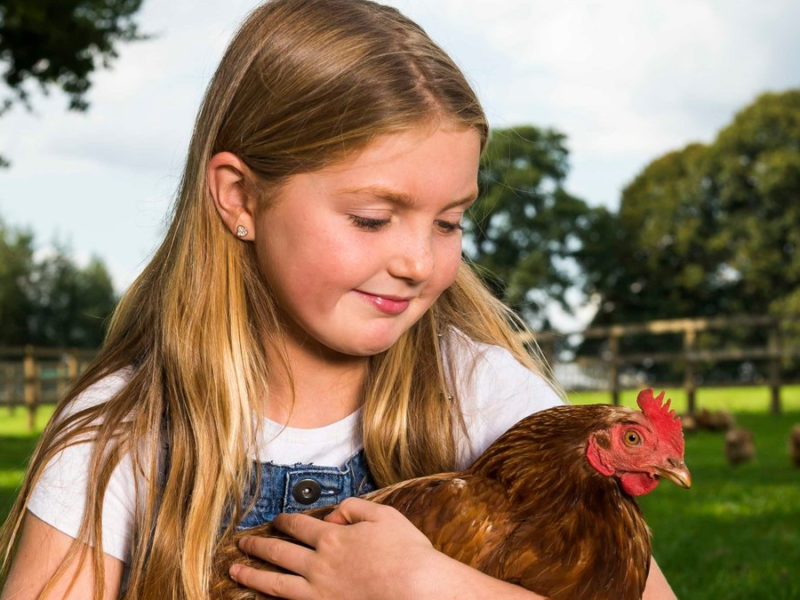
Over the last 50 years, on the three farms the charity, Farms for City Children now runs, over a hundred thousand children have spent a week of their young lives down on the farm, some of them grandparents now. They don’t play at it. They work alongside farmers, do all they can to help, within the bounds of safety. They feed the sheep and the pigs, they work in the vegetable garden, they plant trees, they look after the hens. They go away knowing now what it takes for a farmer to make the food we eat. They go away remembering sights and sounds they’ll never forget, buzzards wheeling high above them, mewing. They might see a salmon rising in the river, or a frog in a puddle.
After such a life-changing week they know how important the countryside is, how it is to work on the land in all weathers. They have done it themselves, and felt a new sense of belonging. They see farm animals well looked after and cared for. They have done it themselves. They have dug the potatoes and know they don’t come just from supermarkets. They have stood in a hillside and looked out over wide fields and woods, and loved it. It is precious to them, and they do not forget. What we love we protect.
Michael Morpurgo, began writing stories in the early ’70’s, in response to the children in his class at the primary school where he taught in Kent. One of the UK’s best-loved authors and storytellers, Michael was appointed Children’s Laureate in 2003, a post he helped to set up with Ted Hughes in 1999. Michael has now written over 150 books, including Private Peaceful, Kensuke’s Kingdom, The Butterfly Lion, and War Horse, which became a hugely successful production from the National Theatre and then, in 2011, for a film directed by Steven Spielberg. He was awarded an OBE in 2007 and a Knighthood in the New Year’s Honours in 2018 for services to literature and charity.

With his wife Clare, he set up the charity Farms for City Children, which offers children and teachers from inner-city primary schools the chance to live and work in the countryside for a week on one of the charity’s three farms in Devon, Gloucestershire and Wales. Over 100,000 children have visited the three farms run by the charity since it began in 1976. Teachers frequently comment that a child can learn more in a week on the farm than a year in the classroom. HRH The Princess Royal is Patron of the charity. The couple were awarded MBE’s for their work in education.
Sir Michael Morpurgo will be speaking at the Sheldonian Theatre in Oxford on Saturday 21st March on the importance of nature, as part of the Oxford Literary Festival https://oxfordliteraryfestival.org/
Farms for City Children https://farmsforcitychildren.org/