
ENDING FACTORY FARMING BY 2040: WHY IT’S ESSENTIAL AND HOW WE GET THERE


The food system that fed the past is now threatening the future
National leaders, whether they be Presidents or Prime Ministers, tend to have their work cut out focusing on defence, the economy, public health and the nation’s future prosperity. But there’s one issue that increasingly touches all of these: factory farming.
On the face of it, factory farming may seem out of sight and out of mind. Yet the mass production of animals and crops through confinement, cages, chemical inputs and practices that work against nature rather than with it is increasingly being linked to some of the greatest challenges of our age.
Climate breakdown, wildlife decline, polluted rivers, antibiotic resistance, diet-related illness, and food insecurity itself. Indeed, a recent UK government national security assessment identified risks associated with our food system that can no longer be ignored.
The obvious question is: what do we do about it?
Well, the first thing to remember is that factory farming didn’t arrive by accident. It was not simply the byproduct of progress or human ingenuity. It was built – deliberately and systematically – in the aftermath of the Second World War, when governments across the developed world made a conscious choice to maximise food production at almost any cost.
That choice reshaped farming forever. It delivered abundance, but also sowed the seeds of many of the crises we now face: collapsing wildlife, polluted rivers, climatechanging emissions, widespread animal suffering and diets that damage human health.
Today, we find ourselves at another turning point in history. Once again, food lies at the heart of global challenges – from climate breakdown and biodiversity loss to the rise of chronic disease. And once again, we face a choice: do we cling to the model we inherited, or redesign it for a better world?
This time, something feels different. The pressure for change is no longer coming from one direction alone. It is building from the ground up – and increasingly, from the global stage down as well.

How factory farming came to be
To understand why things must change, it helps to remember how the current system was built.
In 1943, with a world war still raging, representatives from 44 countries gathered at Hot Springs, Virginia, for the United Nations Conference on Food and Agriculture. Its goal was simple and urgent: to banish hunger and stabilise a fragile world. From it came the Food and Agriculture Organisation of the United Nations, tasked with improving diets and increasing food production.
The problem was not the ambition, but how it was interpreted. Food security came to mean yield above all else. Governments threw their weight behind intensification. Subsidies rewarded output, not outcomes. Animals were bred for rapid growth and confined in ever larger numbers. Land was simplified. Efficiency became the overriding goal.
It worked – if measured in tonnes produced. But over time, its costs have become outsized and impossible to ignore.
Factory farming now contributes significantly to climate change, drives deforestation and biodiversity loss, pollutes water systems, and creates conditions ripe for disease. It depends heavily on antibiotics, fuelling antimicrobial resistance that threatens modern medicine. And it subjects billions of sentient animals to lives of severe confinement.
This was not an inevitability of history. It was a design choice.
Which means it can be redesigned.

Change begins with people
One of the most important shifts in recent years has been the growing role of us all as citizens in driving that redesign.
Public concern about how animals are treated – and about the wider impacts of food production – has steadily risen. People are writing to their elected representatives, scrutinising where their food comes from, choosing differently when they can, and making their voices heard through campaigns and social media.
On their own, these actions might seem small. But together, they are shifting the political and commercial landscape.
Governments rarely move far ahead of public opinion. Companies are acutely sensitive to reputational risk. Investors are increasingly alert to societal expectations. In this way, pressure builds from the ground up – not always dramatically, but persistently and cumulatively.
Over time, this begins to change what is possible.
What we are witnessing is not just changing consumer preference, but the early stages of something larger: a movement for a different kind of food system – one that values health, fairness and compassion as well as productivity.
A global moment for food systems
At the same time, there is growing recognition at the highest levels that food systems must change.
Under UN SecretaryGeneral António Guterres, the transformation of the world’s food systems has become a major global priority. It sits alongside climate, biodiversity and public health as one of the defining challenges of our time.
The UN Food Systems Summit in 2021 marked a turning point, bringing governments, businesses and civil society together around a shared recognition: that the current system is not sustainable, and must evolve.
Since then, efforts have continued to shape what that transformation should look like. Compassion has had the privilege of being involved in that process, including as an officially appointed Champion of the summit. We have since built on this work through being chosen by the UN Deputy Secretary General, Amina Mohammed, to join her UN Food Systems Advisory Board.
North Star principles
What has become clear is that the debate is no longer about whether to change, but how.
Compassion’s role on the global stage is to grow consensus around three essential principles of what future food systems should look like.
First, we must use what we grow more wisely – prioritising feeding people first rather than cycling vast quantities of crops through animals in intensive systems.
Secondly, we must respect the limits of Mother Earth – producing food within planetary boundaries, in ways that protect our climate and restore nature.
And thirdly, we must recognise that the health and welfare of people, animals and the environment are inseparable – what is increasingly described and gaining traction in government policy circles as a “One Health” approach.
These ideas are no longer fringe. They are becoming part of the global conversation.

Signs of a new direction
We are also beginning to see these shifts reflected closer to home.
Recently, as President of Eurogroup for Animals, I had the honour of representing animal welfare in the EU’s Strategic Dialogue on the Future of Agriculture, bringing together farmers, businesses, policymakers and civil society.
It was not always an easy conversation, but it led to an important conclusion: that Europe’s food system must, by the 2030s, be economically viable, environmentally sustainable and socially responsible – including much higher standards of animal welfare.
Amongst the consensus recommendations was that the EU should phase out cages.
Perhaps most striking was the recognition that this cannot be achieved through piecemeal change. Agricultural policy, health policy, climate targets, finance and trade all need to pull in the same direction.
In other words, a new direction is required. And everyone needs to play their part.
What needs to happen
Just as factory farming was built through aligned decisions – policies, subsidies, and official encouragement – ending it will require policy coherence and alignment once again.
Governments must lead, particularly through the laws they pass and how they spend public money. Subsidies that currently reward scale and intensity need to shift towards supporting farmers who deliver better outcomes – for animals, nature and public health. Clear timelines to phase out cages and extreme confinement can provide the certainty needed for investment and transition.
Businesses also have a critical role. Many have already committed to going cagefree, or to better broiler chicken standards, or higher welfare raising of fish.
The next step is deeper change: supporting farming systems that prioritise quality over quantity and helping to normalise diets that include less but betterproduced meat.
The financial sector, too, is waking up to the risks. Intensive agricultural systems are increasingly exposed to climate shocks, disease outbreaks and regulatory change.
Redirecting investment towards more resilient, higherwelfare models will be essential.
And underpinning all of this must be continued public engagement – not as a passing trend, but as a sustained force shaping the system from the ground up.
A different kind of progress
The challenge is not to produce less food, but to produce it differently – and to use it more wisely.
This is not about turning back the clock or asking people to make unreasonable sacrifices. It is about building a system that works better: for farmers, for animals, for public health and for the natural world.
We have redesigned our food system before, under very different circumstances. We did so in response to fear and scarcity.
Now we have the opportunity to do so again – guided by knowledge, experience and a deeper understanding of what is at stake.
Ending factory farming by 2040 may sound ambitious. But it is no more ambitious than the system that created it. And this time, the goal is not simply to produce more, but to produce better.
Factory farming was a product of its time — a response to fear, scarcity and a narrow definition of progress. Today, we know that business as usual is not an option. A system that drives climate breakdown, erodes our soils and unravels the natural world ultimately robs us of our future. The question is no longer whether we can change our food system, but whether we will – and whether we choose to build one with compassion at its heart and thereby sustains life in every sense.
Note: A shortened version of this blog was published in The Scotsman on Friday 10th July, 2026
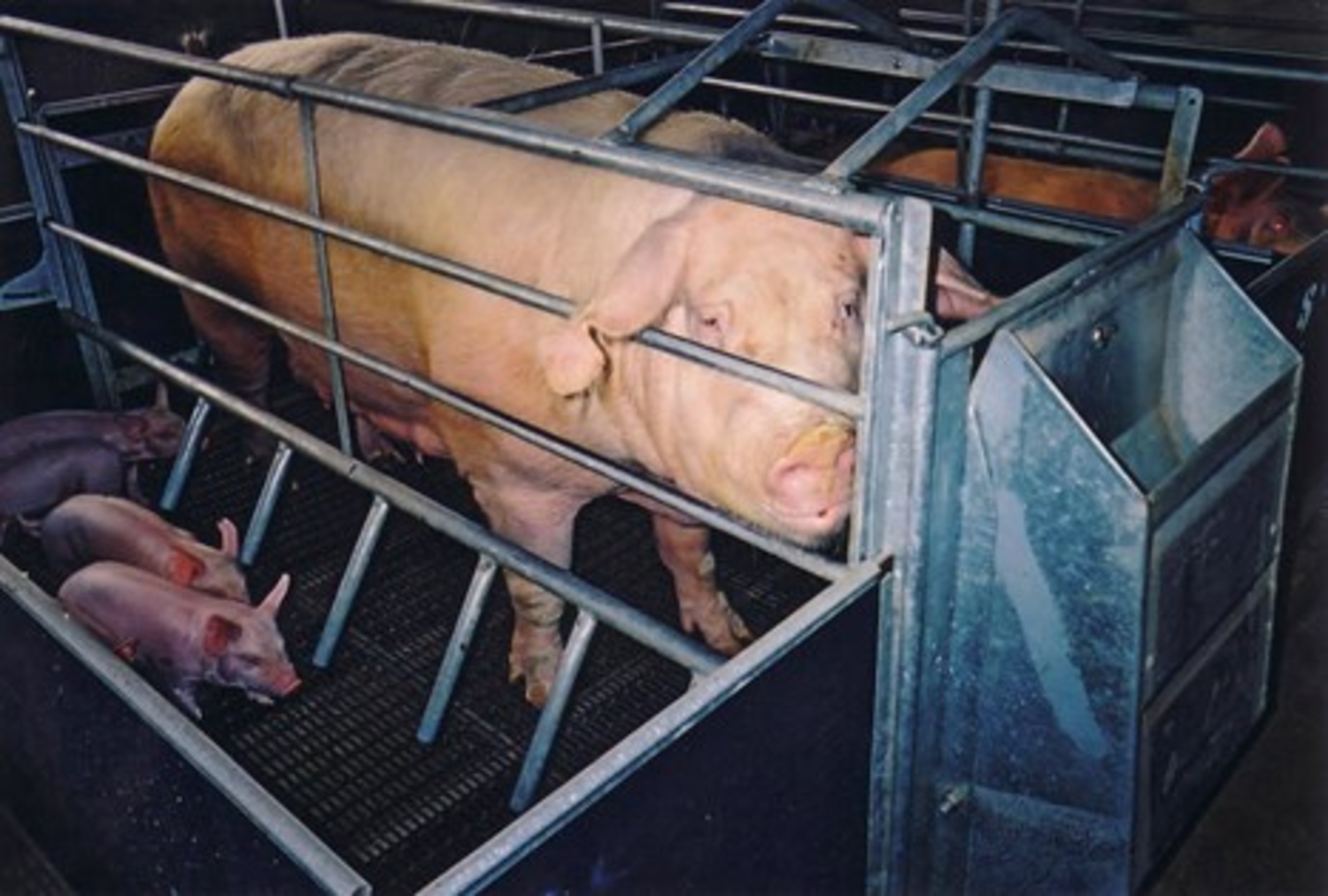
Main Image: Sow standing on meshed floor farrowing crate with her piglets | Credit: Compassion in World Farming