
IRAN WAR SHOWS HOW FRAGILE OUR FOOD SYSTEM REALLY IS
What this Conflict Reveals About Our Dangerous Dependence on Fertiliser
If the US-Israeli war in Iran has taught us anything it’s just how vulnerable we all are to what goes on elsewhere in the world. Whether it be filling up the car, or the cost of weekly shopping, or supplies of fertiliser for our farmers, actions in far-off lands can and do have a lasting impact on our daily lives.
Despite climate concerns, the conflict-driven blockade of the Strait of Hormuz has highlighted just how much we still depend on fossil fuels – and that’s as true for food as anything.
Around a third of the world’s fertilisers normally pass through the Strait of Hormuz. The shipping blockage has increased fears that reduced crop yields from lower fertiliser use could lead to a bidding war for food, driving up prices, pushing more people toward hunger.
Fertiliser shortages caused by the Iran war are thought to have driven up costs for UK farmers by up to 70%. The impact on food prices next year could be dramatic.
Mark Preston from the influential Grosvener Group, summed it up: “It’s going to be a very, very dramatic problem for the world, not just the UK in terms of food, just because so much fertiliser comes through those straits”.
Fossil fuel fragility
Our food system has become fragile. The intensification of agriculture over recent decades has meant that food and farming has become fundamentally rooted in fossil fuels. Food systems now consume 40 per cent of all petrochemicals and 15 per cent of fossil fuels globally.
Fertilisers are a prime example – we use huge amounts of the stuff to grow our crops – most produced using fossil fuels as both ingredient and in manufacturing. These artificial fertilisers – those manufactured, rather than natural organic fertilisers such as manure from grazing animals – are essentially fossil fuels in another form.
Which not only contributes to climate breakdown but makes our food system susceptible to price shocks and disruption of availability.
Whilst artificial fertilisers keep crop yields high for now, they mask serious damage to the very thing we need for food in the future – soil. Artificial fertilisers damage soil fertility. As the soil breaks down, so too does its ability to hold carbon and water.
A brighter future
Thankfully, there is a clear alternative – nature-friendly farming – using regenerative and organic practices. Getting us off the addiction to fossil-fuel-fertiliser. Producing food in harmony with nature. In ways that restore soil health and biodiversity. That bring grazing animals back to the land where they can enjoy fresh air and freedom. That use natural resources for replenishing the soils, thereby increasing the ability of the earth beneath our feet to hold onto water and to capture carbon.
Regenerative farms are less reliant on imported synthetic fertilisers whilst having much lower costs. They improve the soil’s natural fertility with compost, animal manure, rotational grazing, and cover crops.
A 2025 report by the European Alliance for Regenerative Agriculture (EARA) found that yields on regenerative farms were only 2 per cent lower than their traditional counterparts. Meanwhile costly inputs were significantly lower – 61 per cent less synthetic nitrogen fertiliser and much lower pesticide use.
The potential for producing food using more sustainable farming practices is huge – the key to making it happen is providing strong support for farmers in the transition.
Showing support
Farmers aren’t to blame for the food system we have now – it is the product of many years of government policies and subsidies encouraging intensification. Farmers are however the first to be hit by damaging consequences – extreme weather and climate effects. Floods and drought can decimate crops and livelihoods. Hiking input prices can devastate businesses. According to the UK National Farmers Union, the latter has left farmers “bereft of confidence“.
Andy Cato, a leading regenerative farmer who I recently shared the stage with, summarised the dilemma: “To all of the traditional risk that farmers have been shouldering for decades, we’re now adding massive climatic volatility and massive price volatility – and it’s just not a reasonable ask. We just can’t keep doing this, and farmers won’t keep doing this”.
As one half of electronic act, Groove Armada, Cato has gone from music star to champion of regenerative farming. His journey began with reading an article about the environmental consequences of food production on the way back from playing a gig. His farm is testimony to how nature and food production can go hand in hand.
“What keeps me going is that we have a solution here to so many of the existing problems that we face – from health, to climate, to biodiversity,” he told the BBC. “Once you’ve seen its potential, you can’t really walk away from it.”
Creating a better way
As Cato suggests, farming then holds the key to tackling some of the biggest challenges we’re now facing. Getting behind them is vital in helping move away from a dependence on artificial fertilisers, pesticides, cages and crates. In this way we can reduce reliance on fossil fuel products shipped through the Strait of Hormuz.
Encouraging and enabling the transition to nature-friendly farming has never been more urgent. Governments must set a new course – one that works with nature, not against it. And as consumers, we have power too: by choosing pasture-fed, free range, organic and regenerative food, we can help build a food system that is resilient, self-reliant and rooted in compassion. In a fragile world, that may be the surest path to a future we can be proud of.
Note: A version of this article was first published in The Scotsman on Friday 12th June, 2026
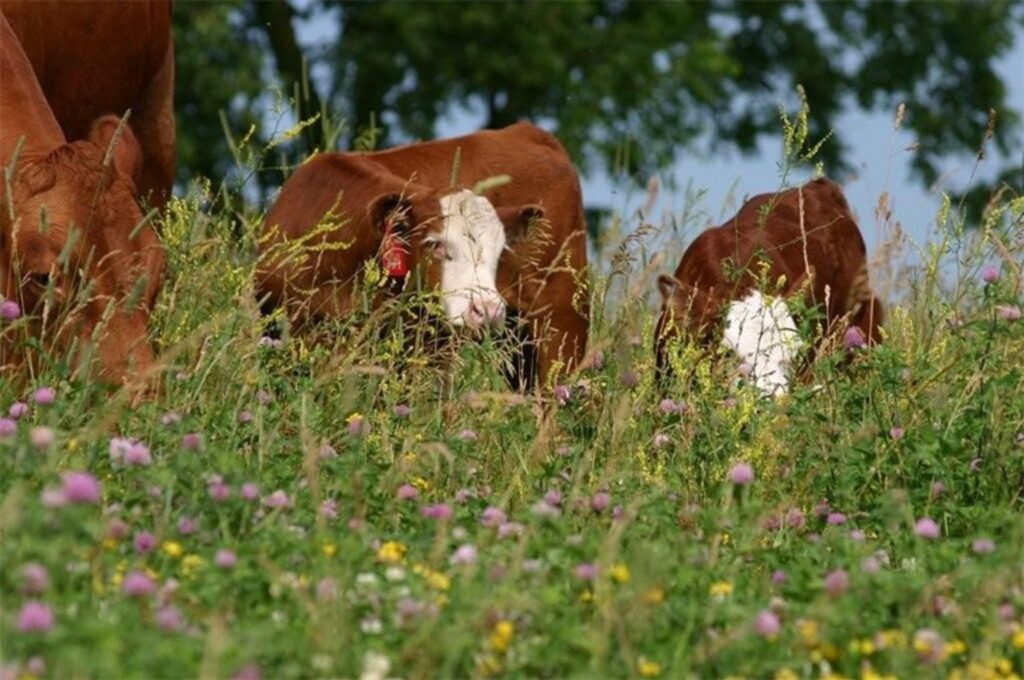
Main Image: Cows in field on a regenerative farm | Credit: CIWF